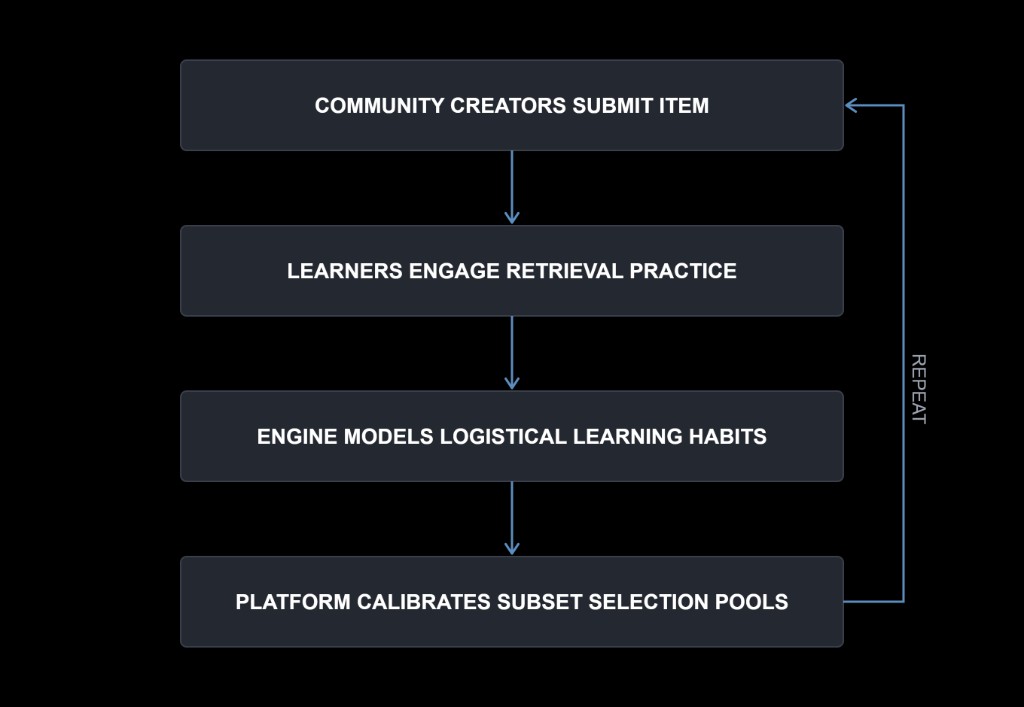
The Engineering Behind QuizHub
Most practice exam sites work the same way: pick a quiz, answer some questions, get a score. That's a fine model for killing five minutes. It's a poor model for preparing to pass a certification exam that will test how well you can apply knowledge under pressure, across scenarios, against a published blueprint.
QuizHub was built around a different premise: a practice platform should adapt to the person using it, not the other way around.
Why We Built It This Way
A percentage score tells you how you did. It doesn't tell you what to do next. Two learners can both score 70% on the same certification quiz and need completely different study plans — one might be weak on a single domain, the other might be spread thin across several but strong where it counts most. Treating them identically wastes their time.
So instead of a single static question list, QuizHub runs practice sessions through an adaptive engine that looks at what you've seen, what you've gotten right or wrong, how consistently, and how that maps against the actual structure of the exam you're studying for — then builds the session around that.
Grounded in Established Learning Science
None of this is novel psychology. It's the application of decades of cognitive research to software that usually ignores it.
Retrieval practice. The single best-supported finding in learning research is that actively recalling information builds stronger memory than re-reading it. This is often called the testing effect, and it's been studied extensively since Roediger and Karpicke's foundational work in the mid-2000s. QuizHub's study mode is built around this directly — you commit to an answer before you see feedback. Recognizing the right answer isn't the goal. Producing it is.
Spacing and reinforcement. Knowledge fades on a predictable curve, a phenomenon first quantified by Hermann Ebbinghaus over a century ago. QuizHub tracks your performance on individual questions over time — not just whether you got the most recent attempt right, but your track record — so material you've demonstrably mastered gets deprioritized, and material you keep missing resurfaces more often. This is the same logic behind spaced-repetition systems like the Leitner method: correct, consistent answers move a question down your priority list; wrong answers move it back up.
Desirable difficulty. Psychologist Robert Bjork's research on "desirable difficulties" showed that learning conditions which feel harder in the moment often produce better long-term retention than conditions that feel easy. QuizHub doesn't quietly remove questions you struggle with — it treats repeated struggle as a signal to reinforce, not avoid.
Metacognition. Strong learners know what they don't know. QuizHub tracks more than right-or-wrong: whether you changed an answer after marking it for review, and whether that change made things better or worse. Over time that builds a picture of your calibration — not just your accuracy, but how well your confidence matches your actual performance.
The Adaptive Engine
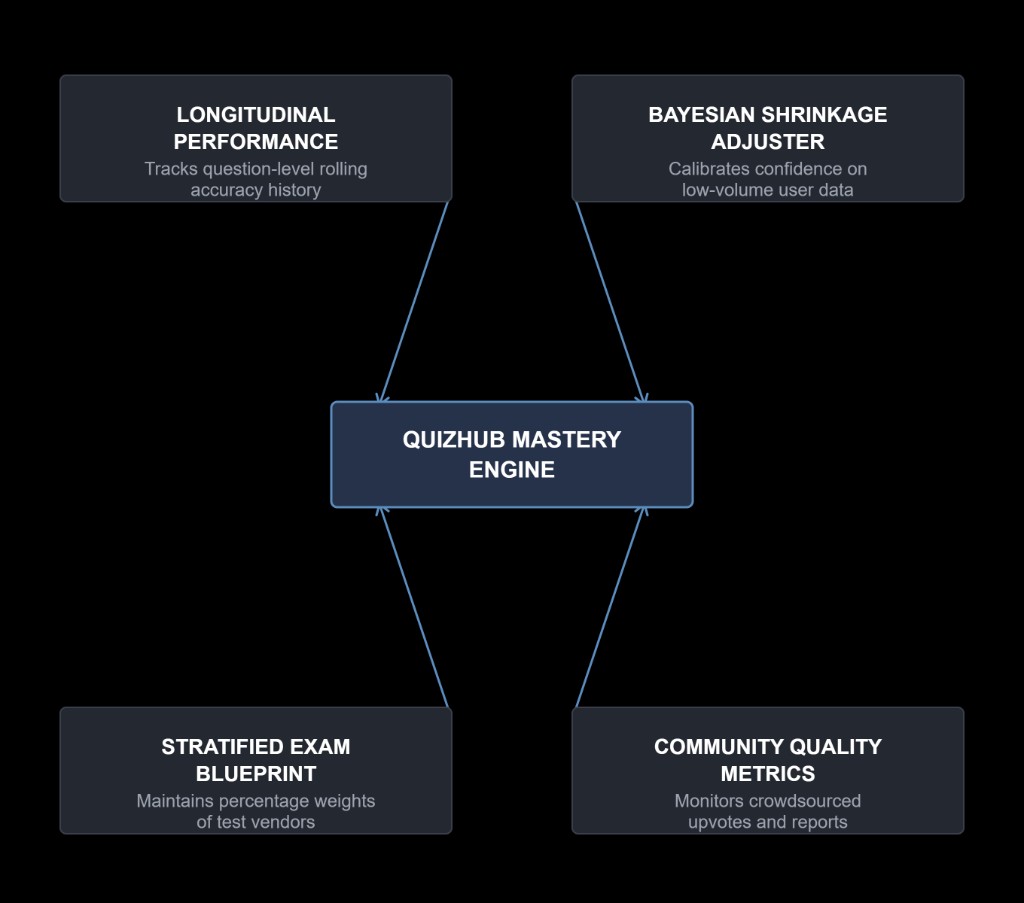
Underneath a QuizHub study session is what we call the QuizHub Adaptive Engine — the system that decides which questions you see and in what order. Rather than one selection rule, it weighs several signals together:
- What you've already seen, and how recently
- Your accuracy history on each question and each topic domain
- The certification's published exam blueprint, when one exists
- Community quality signals on user-submitted content
- Whether questions belong together as part of a connected scenario
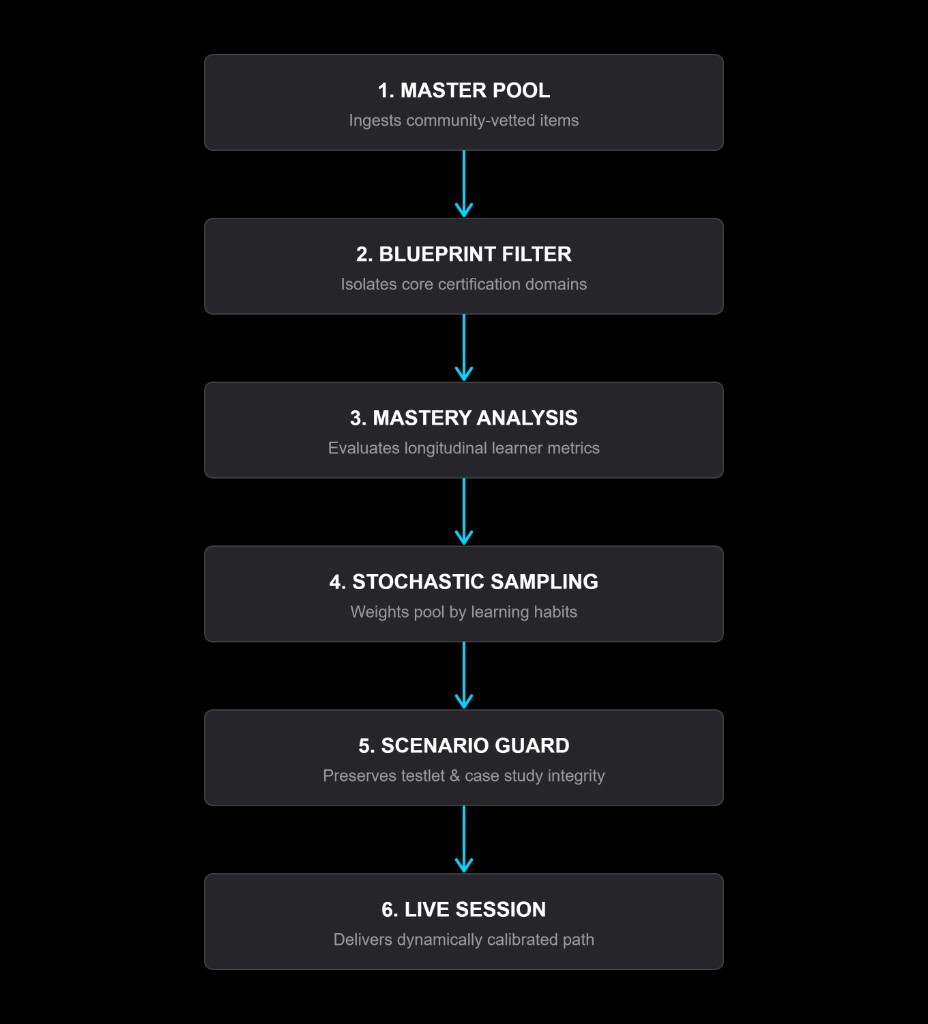
No single factor dominates. A question you've never seen, in a domain where you're historically weak, that also happens to carry heavy weight on the real exam blueprint, will surface differently than a question you've already mastered in a domain you're strong in. The engine's job is to keep sessions purposeful instead of random.
Scenario Integrity: Testlet-Based Design
Some real-world problems can't be evaluated one isolated question at a time — a single scenario often requires working through several connected decisions in sequence. In educational measurement, these grouped question sets are called testlets, and they're standard in serious certification exams for exactly this reason: splitting them apart or shuffling them independently destroys the context that makes them meaningful.
QuizHub treats scenario-based question groups as a single atomic unit. They're selected together, presented together, and never interleaved with unrelated questions, so multi-part scenarios stay coherent the way they would on the actual exam.
Sessions That Adjust While You Work
A study session doesn't have to be decided entirely up front. As you answer questions, QuizHub can recognize when you're performing strongly in one area and struggling in another, and shift the remainder of the session to spend more time where it's actually needed — without breaking the session or starting over. The plan you start with isn't necessarily the plan you finish with, because your performance mid-session is itself useful information.
Readiness Is More Than a Percentage
"Are you ready for the exam?" is a harder question than a single score can answer. QuizHub's readiness assessment draws on several dimensions at once: how you've performed recently versus historically, how your accuracy breaks down by domain relative to the exam blueprint, how much of the material you've actually been exposed to, and how consistent your performance has been over time.
It also accounts for something most practice tools ignore: statistical confidence. If you've only answered a few questions in a given domain, a single lucky guess shouldn't make that domain look mastered. QuizHub applies standard shrinkage techniques — a well-established statistical approach for handling small sample sizes — so early results are treated with appropriate caution rather than taken at face value. Readiness estimates get more precise as you generate more data, by design.
Community Quality Signals
QuizHub's certification content is community-driven, which means quality control has to be built into the system rather than assumed. User-submitted questions carry visible rating signals, and low-rated content can be filtered out of study and exam sessions automatically. New content isn't penalized before it's had a chance to be evaluated — it's treated fairly until enough feedback exists to judge it accurately.
A Platform, Not a Single Exam
QuizHub isn't built around one certification or one vendor. The same adaptive engine, the same testlet architecture, and the same readiness framework apply whether the content is a CompTIA track, a ServiceNow certification, or a knowledge domain someone in the community decides to build out next. The platform is designed to scale by subject matter, not to be rebuilt for each one.
Where This Is Headed
The current engine tracks performance, exposure, and streak-based mastery signals per question. Deeper personalization continues — recognizing not just that you got a question wrong, but why — while the systems below already ship as first-class Mastery Engine capabilities.
Judgment of Learning (JOL) — Metacognitive Confidence
QuizHub captures a 4-point Judgment of Learning scale — No Idea / Guessed / Pretty Sure / Certain — at point-of-answer in study mode, before results are revealed (Nelson & Dunlosky, 1992). Ratings are optional per question; learners can disable prompts globally in Account settings (default on).
Accuracy and confidence are combined into metacognitive signal classes (including the imposter signal — high-confidence wrong — and the instability signal — low-confidence right), consistent with Type-2 signal detection approaches to metacognitive sensitivity (Maniscalco & Lau, 2012). Those signals feed resurfacing weights alongside streak history and domain weakness.
Metacognitive Calibration Monitoring
My Hub surfaces a calibration view: expected accuracy at each confidence level versus your actual accuracy over time. Watching calibration tighten is itself a documented training intervention — not merely a vanity metric.
Spaced Retrieval Scheduling (Expanding Rehearsal)
Every study check updates an SM-2-lite expanding-rehearsal schedule (rooted in the Ebbinghaus forgetting curve and Leitner-style spaced retrieval). Items that are due are prioritized when you enable Spaced retrieval on session setup; overdue reviews appear on My Hub.
Mastery Experience Warm-Start (Bandura Self-Efficacy)
Optional study warm-start prepends a small set of recent personal successes — items you have answered correctly before but have not yet hidden as mastered. This engineers an early mastery experience, the strongest of Bandura’s four sources of self-efficacy, so the session opens with earned confidence rather than a cold plunge into struggle items. Warm-start items are scored normally and count toward session length.
Classical Item Calibration & Parameter Drift Detection
As community and curated banks accumulate responses, QuizHub maintains Classical Test Theory (CTT) difficulty estimates (p-values) per item, locks a calibration baseline after sufficient volume, and monitors parameter drift when live difficulty diverges from that baseline (Kolen & Brennan, 2004). Creators see aggregate drift flags on Creator Stats — soft hygiene for user-generated banks without requiring every author to be a psychometrician.
Encoding Variability and Transfer of Learning
One of the risks of repeated practice is that learners begin remembering the question instead of the concept. Research on encoding variability suggests that memories become stronger when information is learned through different examples, situations, and forms of presentation, while transfer of learning describes the ability to carry that understanding into unfamiliar problems. Certification exams depend heavily on this kind of transfer: the real question is rarely the one you've practiced.
QuizHub is designed to encourage that progression. Each question remains in your study rotation until you've answered it correctly three times in a row, providing evidence that the material has become reliable rather than accidental. Once mastered, that question steps aside, allowing new questions covering the same objectives to take its place. If you choose to borrow verified questions from other quizzes for the same certification, the system gradually replaces familiar wording with new scenarios that test the same underlying knowledge. Over time, study shifts away from recognizing individual questions and toward recognizing the concepts themselves.
Our Philosophy
Technology doesn't automatically produce better learning. Deliberate design does. Every part of how QuizHub selects, sequences, and scores questions exists because it was built to answer one question: does this actually help someone learn the material, not just recognize it.
That's the bar for everything we build.